


Sign 8
Evergreen Tour Starts Here!
Pine, Scots
Pinus sylvestris
- Interest:
- Evergreen
- Family:
- Pine (Pinaceae)
- Form:
- Coniferous Evergreen
Tree
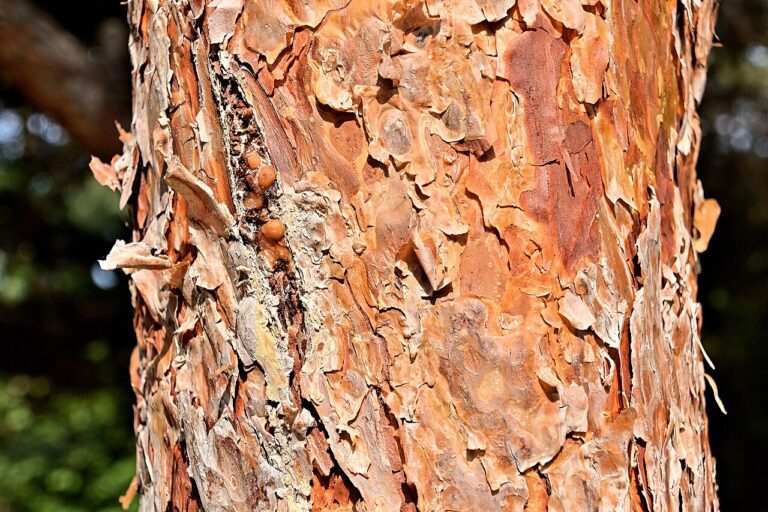
Description: The Scots Pine is a coniferous evergreen known by its orange-red, flaky upper bark and short, twisted, blue-green needles in pairs. Mature trees can reach up to 115 feet tall, with a long, straight trunk topped by a rounded crown. Its seeds feed birds, squirrels and chipmunks.
Scots Pine is Scotland’s national tree and was one of the first trees brought to North America, around 1600. Its timber is used for building, its resin gives tar, rosin and turpentine, and it was a favorite American Christmas tree from the 1950s through the 1980s.
Photo: Akkbula, CC BY-SA 4.0, via Wikimedia Commons

More plant info
What to look for
Look up the trunk. Scots pine is easiest to recognize by its bark: gray-brown and scaly near the ground, but thin, flaky and orange-red higher up. The needles come in pairs, are short (1 to 2 inches), blue-green and often slightly twisted. The small cones take two years to ripen.
Where it comes from
Scots pine is the only pine native to northern Europe. Its range runs from Scotland and western Europe across to eastern Siberia, and north to well inside the Arctic Circle in Scandinavia. Scotland’s old Caledonian Forest was largely Scots pine, and it is Scotland’s national tree.
In North America
It was one of the first trees brought to North America, around 1600, and has been planted widely across the colder parts of the continent. From the 1950s through the 1980s it was one of the most popular Christmas trees in the United States, sold as Scotch pine. In a few places, including Ontario and Michigan, it now spreads on its own and is listed as invasive.
People and Scots pine
It is one of Europe’s most important timber trees, used for building and for paper. In Scandinavia its wood was once made into tar, and its resin is a source of rosin and turpentine.
Sources
Guided tours of the arboretum are free, by appointment. Text Mary at 978-887-4202.