


Sign 9
Pollinator Tour Starts Here!
Hydrangea Climbing
Hydrangea anomala
subsp. petiolaris
- Bloom Time:
- June–July
- Family:
- Hydrangea (Hydrangeaceae)
- Form:
- Vine, Deciduous Woody
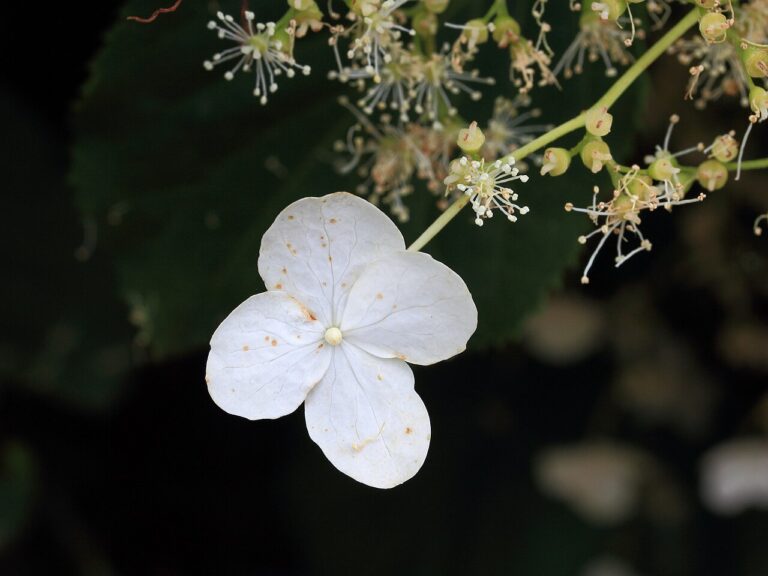
Vine
Description: The Climbing Hydrangea blooms from late spring to early summer, producing fragrant, flat-topped clusters of white flowers (lacecaps) that can last into fall, attracting bees and butterflies. It’s a deciduous woody vine that grows approximately 30-50’ tall x 5-10’ wide.
Climbing Hydrangea’s fragrant summer blooms have shaded arbors and softened stone walls for over a century. In Japan and Korea, young leaves of related species were steamed into a naturally sweet ceremonial tea. Its cascading flowers bring calm and beauty to healing gardens.
Photo: Dominicus Johannes Bergsma, CC BY-SA 3.0, via Wikimedia Commons

More plant info
What to look for
In June and July the vine is covered with flat, lacy flower heads: a ring of large white petal-like florets around a center of tiny creamy flowers. In winter, look at the peeling cinnamon-brown bark on the older stems.
How it climbs
Climbing hydrangea holds onto walls and tree trunks with small aerial roots along its stems, so it needs no tying. Given time it can climb 50 feet or more. It is slow for the first few years, then grows steadily.
Where it comes from
This climbing hydrangea comes from eastern Siberia, Japan and Korea. It has earned the Royal Horticultural Society’s Award of Garden Merit and is one of the few flowering vines that does well on a shady wall.
Sources
Guided tours of the arboretum are free, by appointment. Text Mary at 978-887-4202.