


Sign 13
Dutchman’s Pipe
Aristolochia
macrophylla
- Bloom Time:
- May–June
- Family:
- Birthwort (Aristolochiaceae)
- Form:
- Vine, Deciduous Woody
Vine
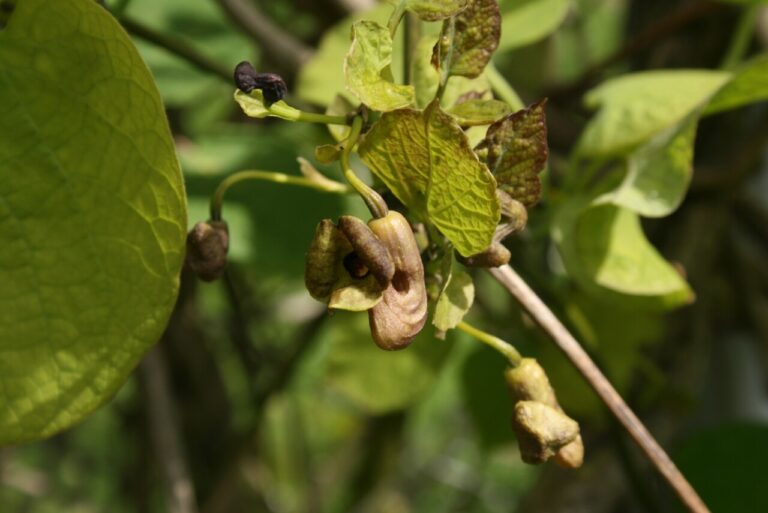
Description: Dutchman’s Pipe vines bloom in late spring, producing unique, pipe-shaped flowers hidden beneath their large leaves. Small flies pollinate the flowers, and the leaves feed caterpillars of the Pipevine Swallowtail butterfly. It’s a deciduous vine that climbs approximately 20-30’. Not edible.
Dutchman’s Pipe was a classic Victorian porch vine, trained over trellises to create cool, shaded spaces before air conditioning. Its flowers resemble old Dutch smoking pipes. Today, it still shelters porches and supports the Pipevine Swallowtail butterfly.
Photo: Sten Porse, CC BY-SA 3.0, via Wikimedia Commons

More plant info
What to look for
Lift a leaf in May or June to find the flowers. They are curved like an old Dutch smoking pipe and hide under the very large, heart-shaped leaves. The vine can grow 30 feet and quickly covers a trellis or porch.
A butterfly’s host plant
Dutchman’s pipe is a native vine of the eastern United States, most common in the Cumberland and Blue Ridge Mountains. It is a host plant for the pipevine swallowtail, a black and iridescent-blue butterfly whose caterpillars feed on its leaves. Eating the plant makes the caterpillars and butterflies distasteful to birds.
Good to know
The whole plant contains aristolochic acid, which damages the kidneys. It should never be eaten or used as a home remedy.
Sources
Guided tours of the arboretum are free, by appointment. Text Mary at 978-887-4202.