


Sign 14
Fir, Douglas
Pseudotsuga menziesii
- Interest:
- Evergreen
- Family:
- Pine (Pinaceae)
- Form:
- Tree, Coniferous Evergreen
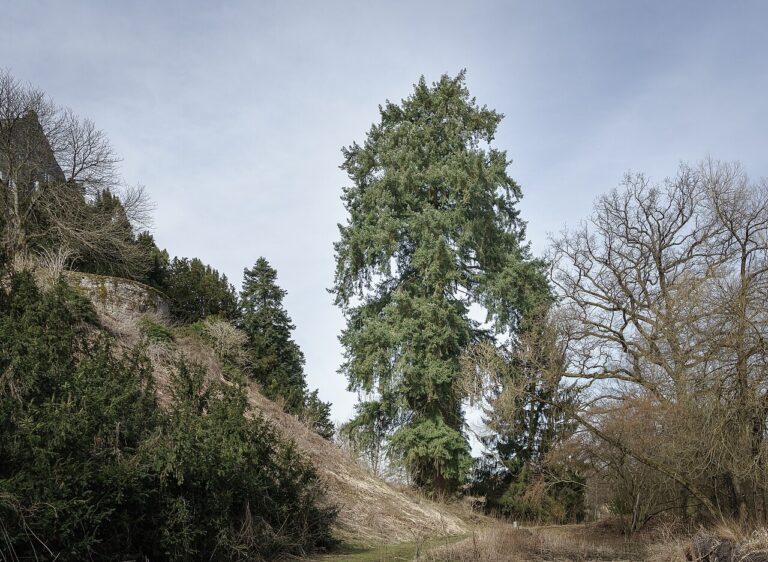
Tree
Description: The Douglas Fir is a large conifer evergreen that grows 40’-80’ tall when cultivated, but can grow up to 300’ tall in the wild. It is home to birds and produces cones in late summer.
Douglas Fir is one of the world’s great timber trees, used for homes, bridges, and railroads across North America. Native peoples used its boughs for bedding and lodge floors and brewed its needles into tea. Its sweet fragrance also makes it a favorite Christmas tree.
Photo: Neptuul, CC BY-SA 4.0, via Wikimedia Commons

More plant info
What to look for
Look at the cones. Douglas fir cones hang down, and between each scale sticks out a three-pointed bract that looks like the back legs and tail of a mouse hiding inside. The needles are soft, flat and fragrant.
Not a true fir
Despite its name, Douglas fir is not a true fir, spruce or pine. Its scientific name, Pseudotsuga, means false hemlock. In its home range in western North America, coast Douglas firs are among the tallest trees in the world, and the oldest have lived more than 1,300 years.
People and Douglas fir
It is one of the most important timber trees in North America, used for framing lumber, plywood and beams. Many Native American nations used its bark, resin and needles in traditional medicine. Its fragrance also makes it a popular Christmas tree.
Sources
Guided tours of the arboretum are free, by appointment. Text Mary at 978-887-4202.