


Sign 3
American Holly
Female & Male
Ilex opaca
- Bloom Time:
- May–June; berries fall–winter
- Family:
- Holly (Aquifoliaceae)
- Form:
- Tree, Evergreen
Tree
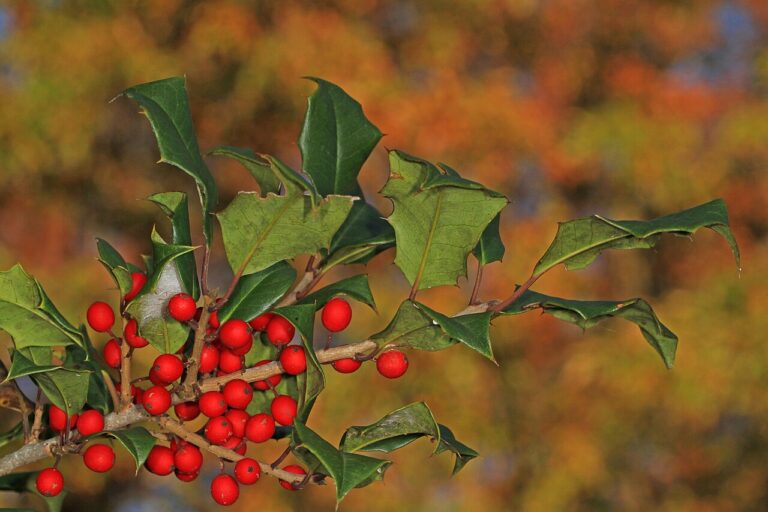
Description: The American Holly features small greenish-white flowers in late spring. Female trees then bear the characteristic red berries, which ripen in fall and often last through winter.
American Holly has decorated homes for winter celebrations since colonial times, a tradition borrowed from Europeans. Native Americans used the berries as buttons, trade goods, and brewed leaves into teas for coughs. Its dense white wood is crafted into inlay, tool handles, & piano keys.
Photo: Judy Gallagher, CC BY 2.0, via Wikimedia Commons

More plant info
What to look for
American holly keeps its spiny, olive-green leaves all winter. Only female trees bear the red berries, and only when a male holly grows nearby to pollinate the small white flowers in late spring. The bark is light gray and roughened by small warty bumps.
A Massachusetts native
Its wild range reaches its northern end on coastal Massachusetts, around Cape Cod, and runs south to central Florida and west to Texas. In the north it is scattered and uncommon; it is much more plentiful along the southern coasts. It tolerates shade and grows naturally beneath taller trees.
The wood
Holly wood is very pale, tough and close-grained, and it takes a high polish. It has been used for whip handles, engraving blocks and cabinet work, and it can be dyed black as a substitute for ebony.
Good to know
The berries feed winter birds but are not safe for people to eat.
Sources
Guided tours of the arboretum are free, by appointment. Text Mary at 978-887-4202.